Scale Your Website Traffic with Smart Programmatic SEO Strategies
In the competitive world of digital marketing, attracting consistent organic traffic is one of the biggest challenges for businesses and websites. Creating individual SEO-optimized pages for every keyword, location, product, or service can take a significant amount of time and resources. This is where Programmatic SEO can make a major difference.
Programmatic SEO is a strategy that uses structured data, templates, automation, and scalable content generation to create large numbers of optimized web pages. When implemented correctly, it can help businesses target thousands of highly specific search queries while maintaining a consistent website structure and user experience.
What Is Programmatic SEO?
Programmatic SEO is the process of creating many SEO-focused web pages using a predefined template and a structured database. Instead of manually creating every page, marketers and developers establish a system that automatically generates pages based on different data points.
For example, a travel website could create pages such as:
- Best Hotels in Bangalore
- Best Hotels in Mysore
- Best Hotels in Mangalore
- Best Hotels in Hyderabad
- Best Hotels in Chennai
Similarly, an education website could target combinations such as:
- Digital Marketing Training in Bangalore
- Digital Marketing Training in Mysore
- Data Science Training in Bangalore
- Python Training in Mangalore
Each page can target a specific search intent while following the same overall content structure.
Why Programmatic SEO Matters for Website Growth
Traditional SEO often focuses on optimizing a limited number of important pages. Programmatic SEO expands this approach by allowing businesses to target a much larger collection of long-tail keywords and search variations.
A well-planned programmatic SEO strategy can help businesses:
- Increase organic search visibility
- Target thousands of long-tail keywords
- Create location-specific landing pages
- Improve keyword coverage
- Capture highly specific search intent
- Generate scalable organic traffic
- Reduce repetitive manual content creation
- Build topical authority in specific industries
The goal is not simply to create more pages. The goal is to create useful pages that answer real search queries.
How Programmatic SEO Works
A successful programmatic SEO system generally combines keyword research, structured data, page templates, content generation, internal linking, and technical SEO.
1. Identify Scalable Search Opportunities
The first step is finding keyword patterns that can be expanded into multiple useful pages.
For example:
[Service] + [Location]
This structure could produce:
- Web Development Training in Bangalore
- Web Development Training in Mysore
- Web Development Training in Mangalore
Another structure could be:
[Product] + [Use Case]
Or:
[Category] + [Feature]
The important factor is identifying a search pattern where users genuinely need different pages.
2. Build a Structured Keyword Database
Once a scalable keyword pattern has been identified, organize the information into a structured database.
A database might include:
- Primary keyword
- Secondary keywords
- Location
- Service
- Product information
- FAQs
- Descriptions
- Supporting content
- Metadata
- URL slug
This database becomes the foundation for automatically generating optimized pages.
3. Create a Reusable Page Template
A strong template ensures that every generated page has a consistent structure.
A typical page could include:
- SEO title
- Meta description
- H1 heading
- Introduction
- Service or product overview
- Key benefits
- Features
- Supporting information
- Frequently asked questions
- Related pages
- Call-to-action
- Internal links
The template should provide structure without making every page feel identical.
4. Add Unique and Valuable Content
One of the biggest mistakes in programmatic SEO is creating hundreds or thousands of pages with minimal differences.
Search engines prioritize helpful content. Therefore, generated pages should provide meaningful information specific to the keyword or user intent.
For example, a location-based training page could include information about:
- Local learning options
- Relevant course features
- Career opportunities
- Course duration
- Learning formats
- Industry applications
- Frequently asked questions
Simply replacing a city name throughout a generic paragraph does not create a genuinely useful page.
Programmatic SEO and Long-Tail Keywords
Long-tail keywords are particularly valuable for programmatic SEO because they often represent highly specific search intent.
Instead of targeting a broad keyword such as “digital marketing training,” a website could target variations such as:
- Digital Marketing Training in Bangalore
- Digital Marketing Course for Beginners
- Online Digital Marketing Training
- Digital Marketing Training with Placement Assistance
- Advanced Digital Marketing Course with AI
These keywords may individually have lower search volumes, but collectively they can generate significant organic traffic.
More importantly, users searching specific queries often have clearer intent, which can result in stronger engagement and conversions.
Creating Location-Based SEO Pages
Location-based programmatic SEO is one of the most common applications of this strategy.
Businesses operating across multiple cities can create dedicated pages for relevant locations.
For example:
Service + City
A training institute could create pages targeting:
- Python Training in Bangalore
- Python Training in Mysore
- Python Training in Mangalore
- Python Training in Hyderabad
However, each location page should provide location-specific value rather than simply replacing the city name.
Useful elements could include:
- Training options
- Course details
- Local career opportunities
- Nearby learning options
- Industry demand
- Frequently asked questions
- Contact information
This approach creates a better experience for both users and search engines.
Programmatic SEO for E-Commerce Websites
E-commerce businesses can use programmatic SEO to scale product and category visibility.
For example, an online store could create landing pages around:
- Product categories
- Brands
- Product attributes
- Product types
- Use cases
- Comparisons
- Locations
A clothing website might target combinations such as:
Category + Style + Audience
This can help the website capture highly specific searches while creating organized pathways for users to discover products.
Programmatic SEO for SaaS Businesses
SaaS companies can also benefit from programmatic SEO by building pages around use cases, integrations, industries, and comparisons.
Examples include:
- CRM for Real Estate Businesses
- CRM for Small Businesses
- CRM for Marketing Teams
- Project Management Software for Startups
- Project Management Tool for Remote Teams
Integration pages can also target searches such as:
- Software A + Software B integration
- How to connect Software A with Software B
These pages can attract users who are already looking for a specific solution.
Internal Linking Is Essential
Generating hundreds of pages without an effective internal linking structure can make it difficult for users and search engines to discover important content.
A programmatic SEO website should establish logical connections between related pages.
For example:
Main Category → Subcategory → Location → Related Services
Internal links can help:
- Improve website navigation
- Distribute link authority
- Help search engines discover pages
- Strengthen topical relevance
- Encourage users to explore related content
A carefully designed internal linking system can turn a collection of individual pages into a well-connected content ecosystem.
Avoiding Duplicate and Thin Content
Scalability should never come at the expense of quality.
A major risk of programmatic SEO is producing pages that are nearly identical except for a few changed words. These pages may provide little additional value to users.
To avoid this problem:
- Add genuinely unique information
- Understand the search intent behind each page
- Use relevant supporting data
- Include unique FAQs where appropriate
- Provide useful examples
- Avoid unnecessary page generation
- Remove or improve low-value pages
- Review automatically generated content regularly
The objective should always be quality at scale, not simply quantity at scale.
Technical SEO for Programmatic Websites
Technical SEO becomes increasingly important as the number of pages grows.
Businesses should pay attention to:
- XML sitemaps
- Canonical URLs
- URL structure
- Page speed
- Mobile responsiveness
- Crawlability
- Indexation
- Breadcrumbs
- Structured data
- Internal linking
- Broken links
- Duplicate URLs
Large websites should also monitor which pages are being indexed and whether search engines are discovering the pages that actually matter.
Using AI with Programmatic SEO
Artificial intelligence can make programmatic SEO workflows more efficient, particularly for research, content ideation, data organization, and content enrichment.
AI can assist with:
- Keyword clustering
- Search-intent analysis
- Content outlines
- FAQ generation
- Metadata suggestions
- Content variations
- Internal-link recommendations
- Content quality checks
However, AI should support the SEO strategy rather than replace human oversight. Content should be reviewed to ensure accuracy, originality, relevance, and usefulness.
Measuring Programmatic SEO Performance
Launching thousands of pages does not automatically guarantee success. Performance should be measured continuously.
Important SEO metrics include:
- Organic traffic
- Keyword rankings
- Click-through rate
- Indexed pages
- Impressions
- Conversions
- Engagement
- Bounce or engagement signals
- Internal-link performance
- Pages generating organic leads
Analytics can reveal which page templates and keyword combinations are producing the strongest results.
For example, if location-based pages generate strong impressions but very few clicks, their titles and descriptions may need improvement. If certain pages receive traffic but do not convert, the landing-page content or call-to-action may need refinement.
Common Programmatic SEO Mistakes
While programmatic SEO offers significant growth opportunities, poor implementation can create serious SEO problems.
Common mistakes include:
Creating Too Many Low-Value Pages
More pages do not necessarily mean more traffic. Every page should serve a clear purpose.
Using the Same Content Everywhere
Replacing only a keyword or location name creates pages that may feel repetitive and provide little value.
Ignoring Search Intent
A page should answer what the user actually wants to know rather than simply targeting a keyword.
Poor URL Structures
Complicated or inconsistent URLs can make large websites harder to manage and navigate.
Weak Internal Linking
Pages that are not properly connected may remain difficult for users and search engines to discover.
Forgetting Conversion Optimization
Organic traffic is valuable, but businesses also need visitors to take meaningful actions such as making an enquiry, signing up, booking a demo, or purchasing a product.
Best Practices for Smart Programmatic SEO
To build a sustainable programmatic SEO strategy, follow these principles:
- Start with search intent rather than page volume.
- Choose keyword patterns that genuinely scale.
- Use structured and reliable data.
- Create useful page templates.
- Add unique information to every important page.
- Build strong internal linking.
- Optimize technical SEO from the beginning.
- Monitor indexation and organic performance.
- Improve underperforming pages regularly.
- Remove or consolidate pages that provide little value.
The Future of Programmatic SEO
Search is becoming increasingly competitive, and businesses need scalable strategies to reach users across a growing number of search queries. Programmatic SEO provides a framework for expanding organic visibility without relying entirely on manually created pages.
The future of programmatic SEO will likely involve a combination of structured data, automation, AI-assisted content workflows, strong technical SEO, search-intent analysis, and human quality control.
Businesses that focus on creating genuinely useful pages can use programmatic SEO to build extensive search visibility while maintaining a strong user experience.
Final Thoughts
Programmatic SEO can be a powerful way to scale website traffic, especially for businesses with large sets of products, services, locations, audiences, or use cases. But successful implementation requires more than generating thousands of URLs.
The most effective strategy combines keyword research, valuable content, structured data, technical SEO, internal linking, automation, and continuous optimization.
When executed thoughtfully, programmatic SEO can transform a website from a collection of a few optimized pages into a scalable organic search platform capable of reaching users across thousands of relevant search opportunities.
Explore Our Courses
Ready to master the skills discussed in this article? Check out our comprehensive course programs designed by industry experts.
Browse Courses →Explore Our Services
Looking to implement these concepts in your organization? Our services team can help you achieve your business goals.
View Services →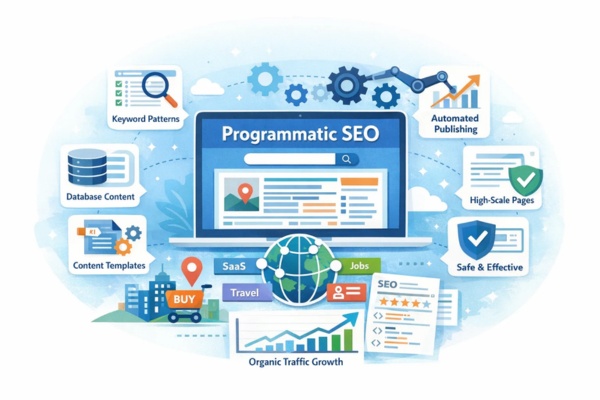




Comments
No comments yet. Be the first to comment!